

A CEO I was working with got a number he didn’t want.
The quarter had missed. The leader who owned it started to explain, and you could feel the rest of the room lean back — waiting to see what he’d do with it.
He said, “Let’s unpack what got in the way, and what you need to hit it next quarter.”
That was it. No speech. But within ten minutes, two other leaders put constraints on the table that they’d been carrying alone for weeks.
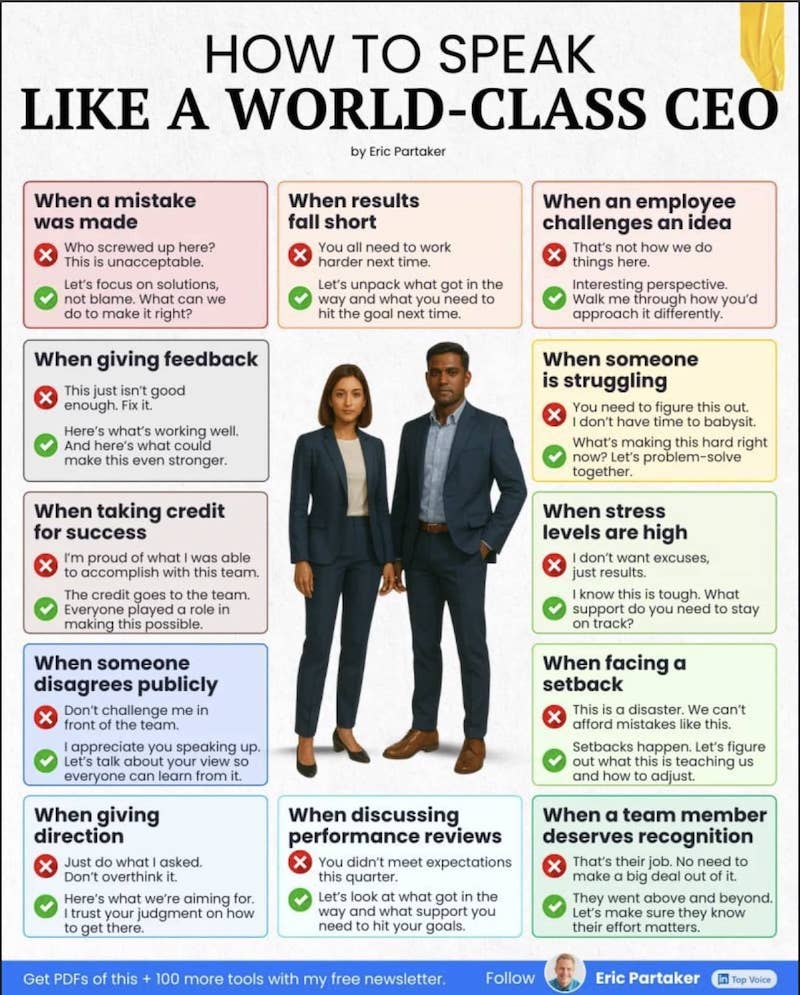
I came across Eric Partaker’s “How to Speak Like a World-Class CEO” chart this week, and it named what I watched happen in that room.
“Who screwed up here?” builds a team that manages its exposure. “Let’s focus on solutions — what can we do to make it right?” builds a team that surfaces problems while they’re still small.
“Don’t challenge me in front of the team” teaches everyone that the real conversation happens in the parking lot. “I appreciate you speaking up — let’s talk about your view so everyone can learn from it” teaches them it happens in the room.
And the one I notice most: “Just do what I asked. Don’t overthink it,” versus “Here’s what we’re aiming for. I trust your judgment on how to get there.”
One produces a team that waits for you. The other produces a team that leads itself.
None of this is a script. The words are a signal — of whether it’s safe to be honest here, and whether ownership is real or on loan.
Most of the CEOs I work with are surprised by how much of their team’s cohesion traces back to a handful of sentences they don’t remember saying.
Think about the last time your team brought you bad news. What did the room hear in your first ten words?
Comments are closed