

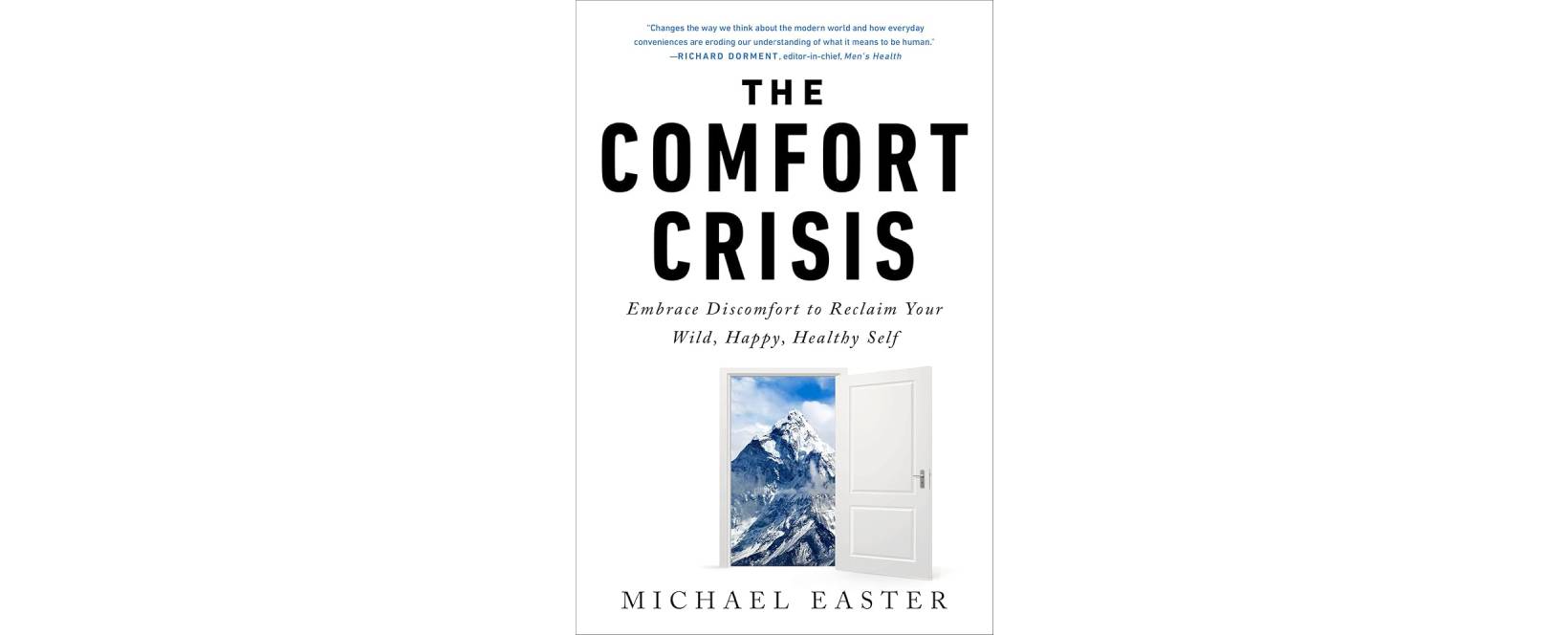
A book worth reading for anyone who senses that comfort is quietly costing them something.
Picture the life of your great-great-grandparent in 1900. Warmth meant splitting wood. A meal meant labor, scarcity, and the genuine possibility of going without. A journey was measured in days and danger. For them, discomfort was not a thermostat-and-streaming inconvenience — it was simply the water they swam in.
Now stretch the timeline back further. For roughly 40,000 years, human beings lived inside near-constant physical challenge: hunger, cold, exertion, and real risk. Our bodies and our minds were forged in that crucible. Then, in a historical blink, we engineered almost all of it away. We are, by any honest measure, more comfortable than almost everyone who has ever lived.
That is the premise of Michael Easter’s The Comfort Crisis: Embrace Discomfort to Reclaim Your Wild, Happy, Healthy Self. Easter’s argument is deceptively simple and hard to shake: we evolved to do difficult things, and a life with the hard parts removed does not make us happier. It tends to make us softer, more anxious, and strangely unfulfilled.
The leaders I work with feel this even when they cannot name it. The most meaningful growth lives at the edge of discomfort —the candid conversation we keep postponing, the feedback we soften until it says nothing, the stretch role we talk ourselves out of. Patrick Lencioni’s entire body of work rests on the same truth: a team only gets healthy when people are willing to sit in the discomfort of vulnerability, conflict, and accountability rather than route politely around them. Comfort is the enemy of a team that leads itself.
So here is the challenge. Read the book — then go choose something hard:
Plan a misogi. Easter borrows this idea: once a year, attempt something genuinely difficult, with roughly a 50% chance of failure. Not a race with a finisher medal — a real edge.
Ruck. Put weight on your back and walk. (My F3 brothers will recognize this one immediately.)
Reclaim boredom. Leave the phone in the other room and let your mind get restless. That discomfort is where ideas live.
Get into nature — regularly, and without a screen.
Welcome a little hunger and a little cold on purpose.
Run toward the hard conversation this week instead of away from it.
Keep mortality in view. Easter writes about cultures that contemplate death daily; perspective turns out to be one of the most practical tools we have.
Growth was never meant to be comfortable. It was never supposed to be. Pick a hard thing, and do it.
Comments are closed